
Two contemporary tables can look nearly identical in a photograph while differing in how they move, how their parts are specified, and how they handle sound or privacy. That difference explains a major direction among conference table manufacturers: design is moving from a single finished object toward a configurable system. The relevant trends can be assessed by asking which material, mechanism, and accessory choices change the table’s performance in an actual meeting room.
Mobility, low-emission boards, coordinated finishes, and optional panels are often grouped together as style claims. They solve different problems. A castor changes room setup; a tabletop core affects the specified material; an acoustic panel can influence the character of a shared workspace. Treating these as separate design decisions makes a modern meeting room table easier to evaluate.
Specify the Material and Support System
Tabletop material is a visible part of a procurement decision, but its published specification needs context. E0-grade particle board with a melamine finish identifies a board class and surface treatment; it does not by itself determine whether a table will remain stable after repeated moving. The frame, brackets, and connection to the top have their own structural roles.
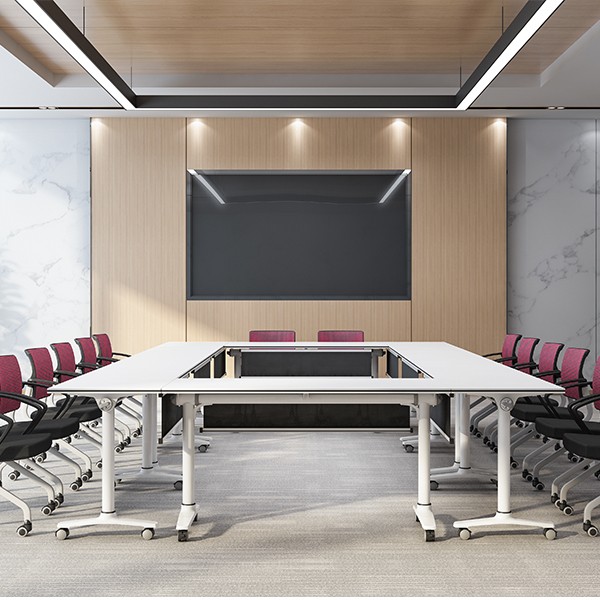
COLIN LS-701 makes that component-level approach concrete in Leadcom Seating‘s range. COLIN pairs a melamine finish with its specified 25 mm thick E0-grade particle-board tabletop. The base is powder-coated aluminum, the column is 1.5 mm powder-coated steel, the beam is 50 × 1.5 mm cold-rolled steel, and the tabletop bracket is 3 mm steel. Each part can be checked against the stresses it faces rather than treated as one vague material claim.
Conference table manufacturers can customize a meeting room table by specifying its frame and top separately. COLIN’s metal frame comes in published lengths of 1150, 1350, and 1750 mm. Corresponding tabletop lengths are 1200, 1400, and 1800 mm, with depth from 500 to 550 mm. The choices let a project match a module to its room without assuming that one top size or leg position fits every use.
Component schedules matter after installation. When replacing a damaged tabletop, buyers should confirm its dimensions, finish, mounting points, and compatibility with the existing frame before ordering. Castors, brackets, and panels need traceable specifications so visually similar options do not become incompatible.
Finish consistency remains important across several rooms. Powder-coated metal can be specified in standard white or optional silver and black for this model. These colors have a design function when mobile tables stand next to fixed furniture, but the finish schedule must identify the selected option for every component. A room can look inconsistent even when all its tables share the same product name.
Make Reconfiguration a Measurable Feature
A flip-top mechanism changes a table’s storage footprint after the working surface is no longer needed. Lockable 2-inch PU castors on COLIN allow movement and a defined parked position. The operational advantage depends on whether staff can fold, roll, and secure several tables within the time available between meetings. Movement should be tested with the intended floor surface and doorway clearances.
Conference table manufacturers increasingly offer modular sizes because meeting formats vary. Several short units can support training rows or small groups, then move aside for an event. A long fixed surface offers a different kind of utility: it stays ready for a stable meeting format. The trend is not universal mobility; it is giving a project enough documented choices to match the frequency of change.
The mechanism also creates maintenance questions. A table that moves often needs accessible locks, a repeatable folding path, and support that remains firm when the top is open. Buyers can ask how the caster, hinge, and bracket are inspected or replaced. A finish may remain attractive while a loose moving joint makes the room difficult to reset.
Repeated changeovers test assembly quality. A trial with several tables can reveal alignment and nesting problems that a sample hides. The frame, top, and castors need evaluation as a group.
Optional accessories can either serve the use case or complicate it. A book rack may support training materials, whereas a frequently moved conference setup may prioritize clear legroom. The choice should be made against the tasks carried out at the table, not by adding every available option.
Treat Privacy and Acoustics as Layout Decisions
COLIN’s optional modesty panels include steel, MFC, mesh fabric, and acoustic-panel versions. A panel can provide visual screening beneath a table or change how its underside looks, while an acoustic version may be relevant where several groups work close together. The performance of a whole room still depends on wall, floor, ceiling, and occupancy conditions; a table panel alone cannot establish an acoustic result.
This is where current design trends become specific. The same meeting room table can be specified with a different panel, size, finish, or mobility setup according to the room’s tasks. An approval sample and component schedule make those options concrete for purchasing and replacement.
A detailed component schedule turns this design trend into separate, checkable requirements for materials, movement, and accessories. Repeated room resets can then reveal whether the chosen hinge, frame, and panels remain suited to the room’s planned meetings through daily use.

